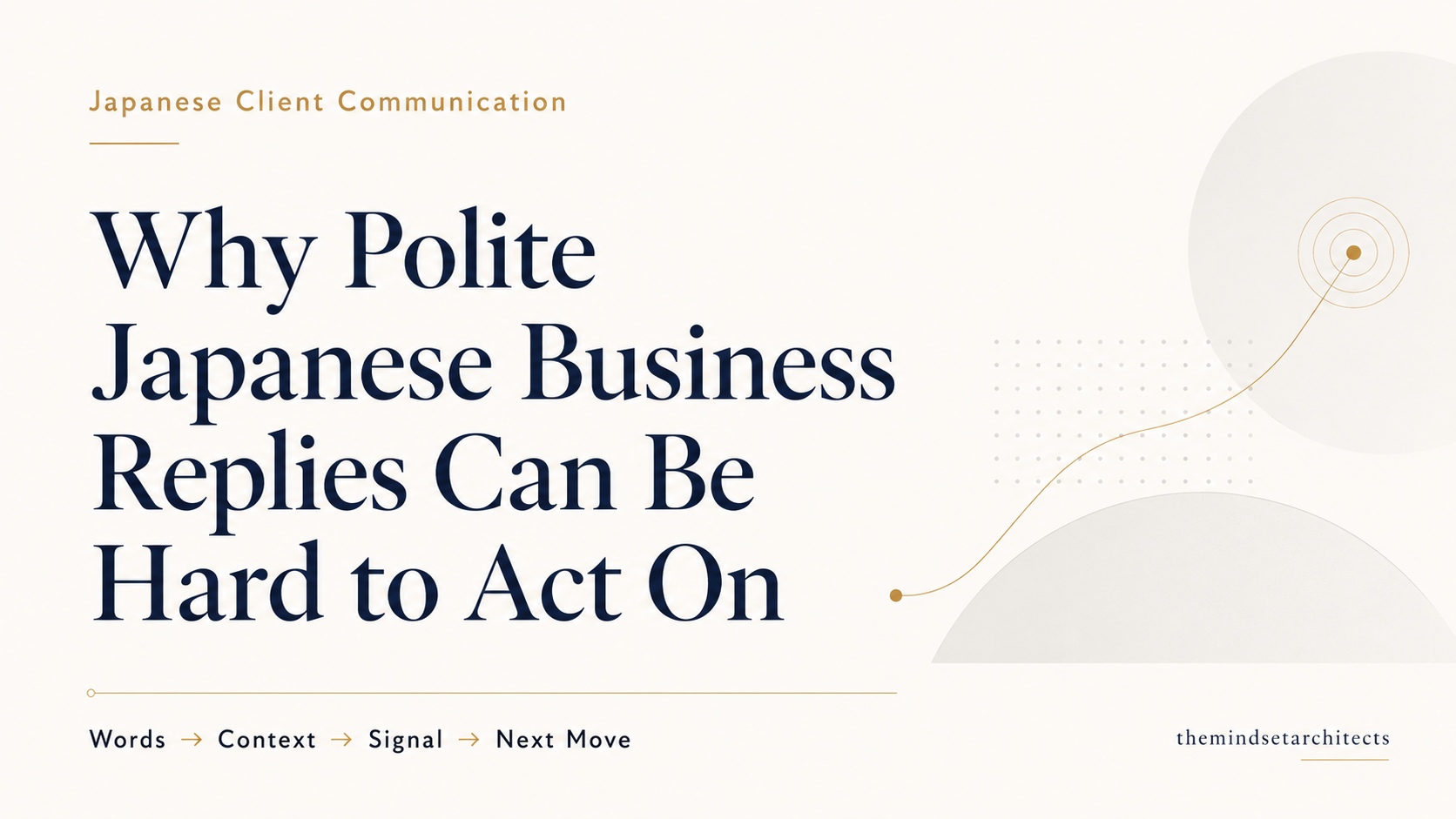
You read the reply. The translation makes sense. But you still don’t know what to do next.
This is one of the most common friction points for professionals working with Japanese clients — and it has nothing to do with language ability.
The Problem Is Not Translation
Japanese business communication places a high value on maintaining harmony and avoiding direct confrontation. As a result, replies are often carefully worded to be polite, considerate, and non-committal — all at the same time.
The translation may be perfectly accurate. But the business signal behind the words can still be unclear.
When a Japanese client writes “We will consider it,” the sentence is correct English. What it does not tell you is whether that means interest, hesitation, a need for internal consensus, or a quiet way of slowing things down.
That gap — between accurate translation and actionable understanding — is where projects stall.
Common Replies That Feel Complete but Leave You Waiting
Here are a few phrases that come up often in Japanese business correspondence:
“We will consider it.” — Polite and professional. But it may signal genuine interest, internal discussion that needs time, or discomfort with a specific aspect of the proposal.
“We will discuss it internally.” — This could mean a standard review process is underway. It could also mean the decision-maker has not been involved yet, and the contact is unsure how to proceed.
“That may be difficult.” — In many business cultures, this means “no.” In Japanese business communication, it often does too — but the degree of finality can vary significantly depending on context.
“Thank you for your understanding.” — Frequently used to close a topic gracefully. It may or may not mean the issue is resolved from the client’s side.
None of these replies are evasive or rude. They reflect a communication style that prioritizes relationship over directness. The challenge for the other party is deciding what to do next.
Why Reacting Immediately Can Backfire
When a reply feels ambiguous, the instinct is often to push — send a follow-up, ask for a clearer answer, or escalate internally.
This approach may work in some business contexts. With Japanese clients, it can create friction that damages the relationship and slows things further.
Pushing for a direct answer when the client is still in internal discussion may signal impatience. Sending a follow-up too quickly after “We will consider it” may feel like pressure. Escalating before giving the client time to align internally can close doors that were still open.
Reading the signal before deciding on the next move tends to produce better outcomes.
A Framework for Reading the Signal
Rather than treating each reply as a language problem, it may help to treat it as a decision point. Four elements are worth examining:
Words — What did the reply actually say, taken at face value?
Context — What was the situation leading up to this reply? Where are you in the project? What was asked?
Signal — Given the words and context together, what might the client be communicating? What are the plausible interpretations?
Next Move — Which action protects the relationship while keeping the project moving? Wait, clarify gently, adjust the ask, or follow up after a set interval?
This is not a formula. It is a way of slowing down the interpretation process so that the response is chosen deliberately, not reactively.
What This Looks Like in Practice
A client replies: “We will discuss it internally and get back to you.”
Words: Internal discussion is needed before a response.
Context: You submitted a revised proposal three days ago. This is the first reply since then.
Signal: The proposal may be moving through review. There may be a stakeholder who has not yet seen it. There is not necessarily a problem — but the timeline is now in their hands.
Next Move: Acknowledge the update, confirm you are available if they have questions, and set a light internal checkpoint for yourself before following up. Do not ask for a deadline unless there is a business-critical reason to do so.
This is one example. The signal and next move will differ depending on the relationship, the stage of the project, and the specific context.
The challenge is not the language. It is deciding what to do next.
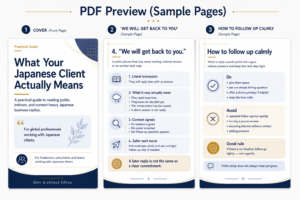
This guide covers 10 common Japanese business reply patterns — with context, possible signals, and action guidance.


コメント
コメント一覧 (1件)
[…] Why Polite Japanese Business Replies Can Be Hard to Act On […]