Your colleague leans over and asks: “So, are they interested or not?” — and you realize the honest answer is “I’m not sure, but I think so, maybe.”
If you’ve ever been in that position — the person on the team who works with Japanese clients and then has to explain what just happened — this article is for you.
Why Explaining Japanese Business Replies Is Harder Than It Sounds
The challenge isn’t language. You can translate the words just fine.
The challenge is that the literal words do not always provide enough information for a business decision. The useful signal often comes from the surrounding context — the timing, the phrasing, the structure of the reply, and the stage of the conversation.
When your colleague asks “Did they say yes or no?”, they’re looking for a clear signal. But many Japanese business replies are designed to preserve relationships and options, not to deliver a direct verdict.
The gap between what was written and what action it should lead to is where misunderstandings happen. And as the bridge person, you are often the one helping the team make that decision carefully.
The Three-Part Explanation Frame
When you’re helping a non-Japanese colleague understand a reply, a structured approach tends to work better than a gut-feel summary. Here’s a simple frame to try:
- Literal meaning — what the words say
Start with a plain translation. Don’t interpret yet. Give your colleague the raw material. - Business context — what’s typical in this kind of situation
Add the layer that doesn’t show up in translation. What does this type of reply usually signal in Japanese business settings? What’s the normal process at this stage? - Safer next move — what might make sense to do next
Rather than declaring what the reply “means,” suggest a lower-risk action. This keeps the relationship intact while the situation becomes clearer.
This frame keeps the explanation grounded and reduces the chance of your colleague jumping to a conclusion that isn’t fully supported yet.
A Concrete Example: “We will consider it”
Suppose your Japanese client replies: “We will consider it internally.”
Here’s how the three-part frame might look in practice:
Literal meaning: They’ve said they’ll take the topic to an internal discussion.
Business context: This kind of reply is common at the mid-stage of a business conversation. It doesn’t confirm interest or rejection. In many cases, it means the topic is now moving through an internal review process, which may take time.
Safer next move: It may be worth sending a brief follow-up — not to push for a decision, but to make it easy for them to come back when they’re ready. Something like a short recap of the key points, or a light check-in after a natural pause.
When you explain it this way to your colleague, you’re not guessing at intent. You’re sharing context and suggesting a low-pressure path forward.
The Words → Context → Signal → Next Move Framework
This four-part structure is a more complete version of the same idea — and it’s useful when a reply feels particularly ambiguous.
Words — What exactly did they write? Start with the literal.
Context — What’s the situation? What stage is the relationship at? What was asked before this reply came in?
Signal — Based on the words and context together, what might this reply be communicating? Use “may” and “possible” — avoid treating your read as certainty.
Next Move — Given that possible signal, what’s a safer action that keeps the relationship intact and doesn’t force a premature decision?
This framework is especially useful when you need to explain your reasoning to a colleague, not just give them a conclusion. It shows your work — and it tends to produce more cautious, relationship-aware next steps.
Your Role as a Bridge Person
Being the bridge person on a team is a specific skill. It’s not just bilingual fluency — it’s the ability to read context, communicate uncertainty without creating panic, and help your team move forward without overreacting to signals that aren’t yet clear.
When you explain a Japanese business reply well, you’re doing more than translating. You’re helping your team make better decisions — and potentially protecting a business relationship that a misreading could damage.
That work has real value, even when it goes unnoticed.
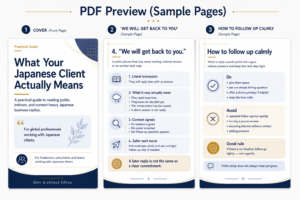
This guide includes a section for bridge people — those who explain Japanese business replies to non-Japanese colleagues. It covers 10 common reply patterns with context, possible signals, and safer next moves.




コメント