You sent a proposal to a Japanese client. They replied:
“We will consider it.”
It sounds polite. It sounds positive. But days pass, then weeks, and you hear nothing.
Was it a yes? A maybe? Or a quiet no?
If you have ever worked with Japanese clients, you have probably been in this situation. This article explains what “we will consider it” may mean in Japanese business communication — and what to do next.
Why “we will consider it” is difficult to read
In many Western business contexts, a reply like “we will consider it” can sound like genuine interest. It may suggest that the conversation is still open.
In Japanese business communication, the same phrase can mean something different depending on the context.
The words on the surface do not always carry the full message.
Japanese business replies often work in layers:
- What the words say literally
- What the tone suggests
- What is missing from the reply
Reading all three together gives you a clearer picture than reading the words alone.
It may mean “we need more time”
Sometimes, “we will consider it” means exactly what it says.
The client may be genuinely reviewing the proposal internally and may not have reached a decision yet.
Signals that this may be the case:
- They asked clarifying questions before this reply
- There is an active project or timeline in the background
- The tone felt warm and engaged earlier in the conversation
- They mentioned a possible next step, even if it was not final
In this case, giving space and following up calmly after a reasonable interval is usually the right move.
It may mean “this is not a priority right now”
Japanese clients may not say directly, “This is not a priority for us.”
Instead, the conversation may slow down quietly.
“We will consider it” with no follow-up question and no timeline can be a signal that the matter has been set aside.
It may not be a rejection.
But it may also not be moving forward.
Signals that this may be the case:
- No timeline or next step was mentioned
- Response time has been getting longer
- Enthusiasm feels lower than earlier in the conversation
- The reply is polite, but very brief
It may mean “no” — said politely
This is the part that often surprises people working with Japanese clients for the first time.
In Japanese business culture, a direct “no” can feel abrupt, especially when both sides want to maintain a polite relationship.
A soft reply may close the conversation without confrontation.
“We will consider it” — with no follow-up, no question, and no timeline — can sometimes function as a careful refusal.
Signals that this may be the case:
- No next step or owner was named
- The reply was formal and brief
- Previous conversations had more detail and warmth
- A deadline you mentioned passed without response
In this situation, pushing harder may not help.
It may create more pressure and make the client less likely to respond.
How to respond without pushing too hard
The instinct when a conversation goes quiet is to follow up more frequently.
In Japanese business communication, this can sometimes have the opposite effect.
Pushing harder after a soft reply may increase discomfort and make the relationship more difficult to recover.
A safer approach is to:
- Wait longer than you normally would before following up
- Ask one calm, low-pressure question
- Offer a smaller next step rather than repeating the original request
- Leave space for the client to re-engage on their own terms
A good follow-up example:
“Thank you for your time. Please let me know if there is anything I can clarify or adjust to make the proposal easier to review.”
This keeps the door open without creating unnecessary pressure.
A practical way to read Japanese client replies
When a Japanese client reply sounds polite but unclear, try reading it at three levels:
- Surface meaning — What do the words say literally?
- Missing signals — Is there a timeline, a next step, or any clear enthusiasm?
- Tone shift — Is this warmer or cooler than earlier messages?
If the surface meaning sounds positive but the missing signals and tone suggest distance, take the cautious interpretation.
Give space before following up.
Do not treat a polite reply as a clear yes unless the next step is also clear.
Other phrases that work in a similar way
“We will consider it” is one of several Japanese business replies that can carry more than their literal meaning.
Other common examples include:
- “We will discuss it internally.” — This may mean the conversation is paused, not progressing.
- “That may be difficult.” — This often functions as a careful or indirect no.
- “We will review it.” — This may mean checking, but not necessarily moving forward.
- “Thank you for your understanding.” — This can carry an expectation that you accept the current situation.
Each phrase has a surface meaning and a context-dependent meaning.
Reading both is what helps you avoid misreading Japanese business communication.
If you work with Japanese clients regularly
Misreading a polite reply once is usually easy to recover from.
But misreading it repeatedly — pushing too hard, following up too often, or missing a quiet no — can gradually damage a client relationship.
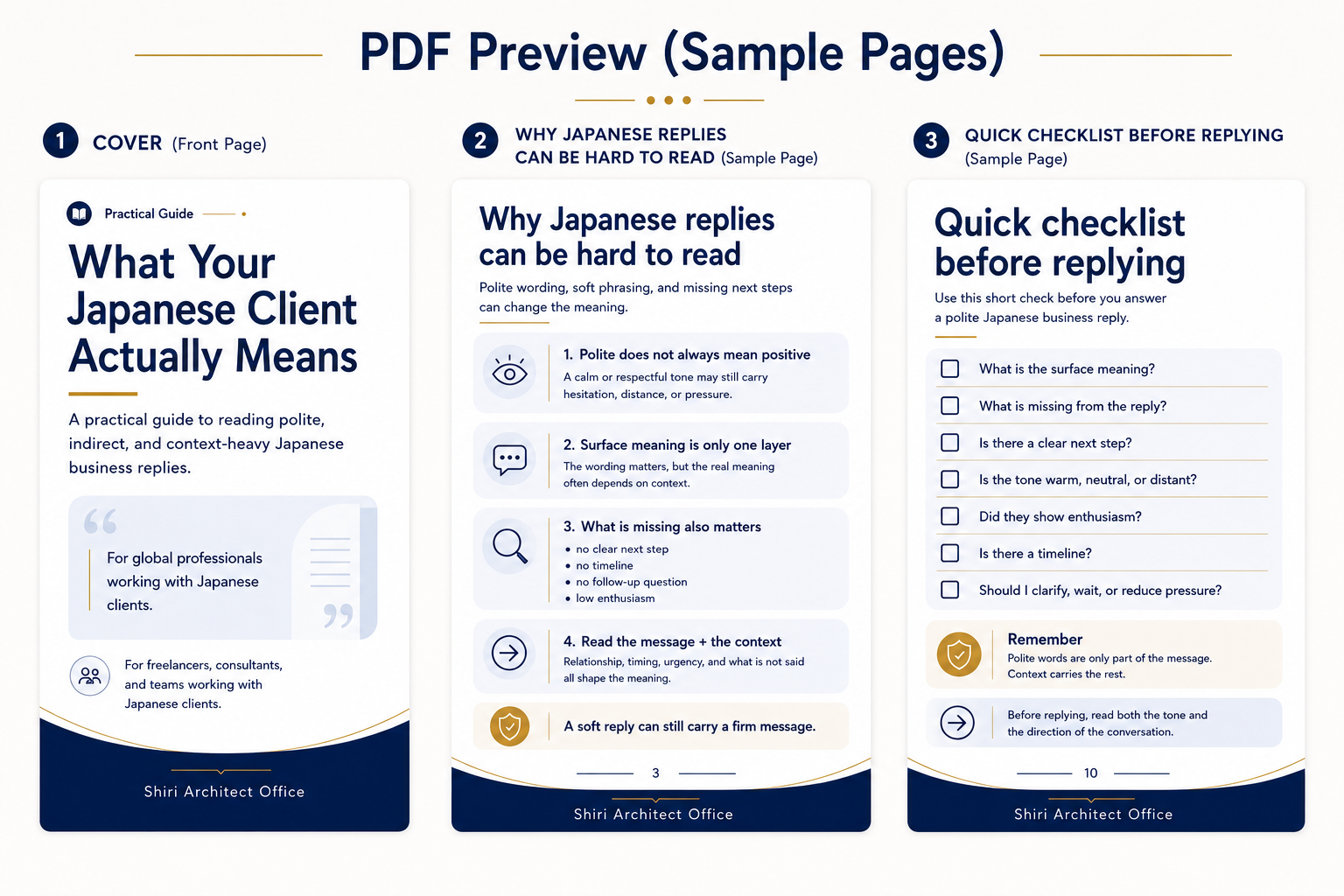
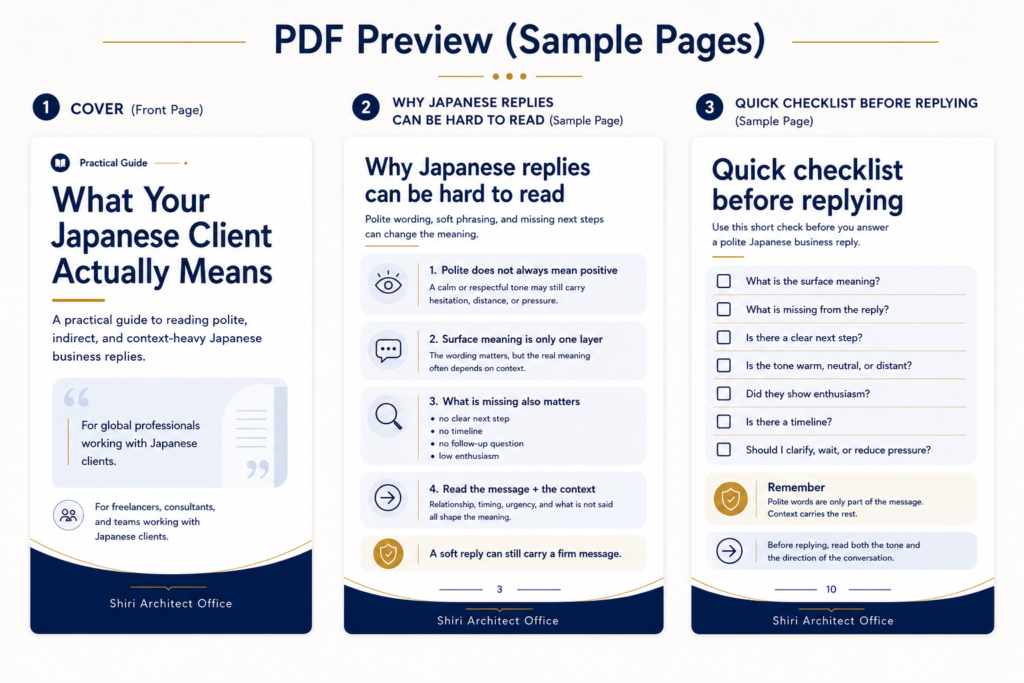
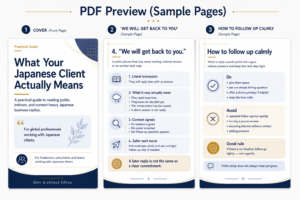
If you often wonder what a Japanese client’s reply actually means, I created a practical PDF guide that covers common phrases in more detail.
What Your Japanese Client Actually Means
A practical guide to reading polite, indirect, and context-heavy Japanese business replies.
For freelancers, consultants, and teams working with Japanese clients.
Written by Atsuko Masamoto — Shiri Architect Office
English-to-Japanese communication and localization specialist based in Japan.




コメント