You sent your proposal, your update, or your question — and the reply came back polite, measured, and completely unclear about what happens next. Now you’re sitting with that message open, trying to decide: do you wait, or do you reach out again?
That moment of uncertainty is exactly what this article is for.
Why This Decision Is Harder Than It Looks
In many business cultures, a slow reply signals disinterest. In Japanese business contexts, a slow reply may mean something different — internal discussion is underway, a decision is being escalated, or the timeline simply operates on a longer cycle than you expected.
The problem isn’t the silence. The problem is that the same reply pattern — “We will get back to you,” “We are checking internally,” “Could you give us a little more time?” — can appear in completely different situations. One requires patience. Another may benefit from a gentle follow-up. A third might call for something else entirely.
Acting too quickly may read as pressure. Waiting too long may read as disengagement. The right move depends not on how many days have passed, but on what the reply is actually signaling.
Signals That Suggest You Should Wait
Some replies carry markers that suggest the other side is still in motion — and that reaching out now could interrupt rather than help.
You may want to wait when:
- A specific timeline was mentioned (“We will respond by end of next week”)
- The reply referenced an internal meeting or approval process that hasn’t concluded yet
- The tone was warmer than usual — expressions of appreciation or reassurance sometimes accompany replies that need time
- A previous follow-up was met with a restatement of the same message, worded identically
When a timeline has been given and that deadline hasn’t passed, waiting is usually the lower-risk option. Following up before the stated window closes may signal distrust of their process.
Signals That Suggest a Follow-Up May Be Appropriate
Other reply patterns may leave the door open for a light, non-pressuring check-in — especially when the thread has gone quiet past a reasonable point.
A follow-up may be appropriate when:
- No timeline was mentioned, and more than two weeks have passed
- The topic involves a deliverable or decision that affects your own planning
- The project has a hard deadline on your end that the other party may not be fully aware of
- A previous reply acknowledged your message but gave no indication of next steps
Even then, the framing of the follow-up matters as much as the timing. A follow-up that opens with your needs may feel like pressure. A follow-up that offers support or asks an easy question tends to land more gently.
Other Options Worth Considering
Waiting and following up are not the only two options. Depending on the reply pattern and context, other moves may fit better.
Clarify — If the reply is ambiguous about what information is still needed, a short clarifying question may move things forward without adding pressure. (“Is there anything from our side that would be helpful as you review this?”)
Reduce pressure — If the pace of the conversation has been fast or the proposal was large, a reply that softens the stakes can help. (“There’s no urgency on our end — please take the time you need.”)
Offer a smaller option — If a large proposal has stalled, offering a smaller starting point may lower the barrier to moving forward. This is not a concession; it’s a way to create momentum at a manageable scale.
The right choice depends on where the stall is coming from — and the reply itself often contains signals that point in a direction.
Reading the Reply: Words → Context → Signal → Next Move
The framework that makes this decision manageable has four steps.
Words — What did the reply actually say? Note the exact phrasing, not your interpretation of it.
Context — What is the situation surrounding the reply? How long has the conversation been going? What was the last proposal or request? Who is involved on their side?
Signal — Given the words and context, what is this reply most likely indicating? Ongoing consideration? Difficulty declining? A need for more time? Uncertainty about scope?
Next Move — Based on the signal, which of the five options fits? Wait / Clarify / Follow up / Reduce pressure / Offer a smaller option.
This sequence slows down the instinct to react and replaces it with a read. In most cases, the signal becomes clearer once you separate the words from your own assumptions about what silence means.
One More Thing Before You Decide
The reply you received may look like many others you’ve seen — but the signal embedded in it may be different. A phrase like “We will discuss internally” from a company that usually responds in two days carries a different weight than the same phrase from a company that routinely takes three weeks.
Pattern recognition builds over time. In the meantime, the framework above can help you work through individual replies in a structured way — without defaulting to either anxious over-following-up or passive waiting that lets momentum stall.
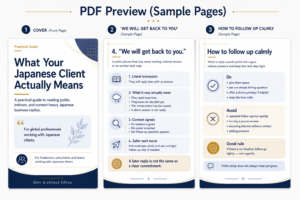
This guide was built for exactly this decision. It covers when to wait, when to clarify, when to follow up, when to reduce pressure, and when to offer a smaller option — across 10 common Japanese business reply patterns.






コメント
コメント一覧 (5件)
[…] English looked polite, professional, and clear. And yet — you still weren’t sure whether to wait, follow up, or change your approach […]
[…] you are not sure whether to follow up, wait, or quietly move on — and the silence is starting to cost you […]
[…] After you have sent a proposal and are waiting on approval […]
[…] Wait with a defined check-in point — Rather than following up immediately, give a realistic window for their process. A brief note — “Please take the time you need. I am available if any questions come up on your side” — acknowledges their process without applying pressure. Then set a specific date in your calendar for a quiet follow-up. […]
[…] you wait too long, the conversation may […]