You sent a message to a Japanese client.
They replied:
“We will get back to you.”
At first, this may sound positive.
It can feel like they are interested, checking internally, and planning to reply soon.
Sometimes, that is true.
But in Japanese business communication, this phrase does not always mean that the conversation is moving forward clearly.
It may also mean that the client needs time, is avoiding a direct answer, or has not decided what to do next.
“We will get back to you” does not always mean progress
In English, this phrase often sounds like a clear promise to reply later.
But when it comes from a Japanese client, the meaning can depend heavily on context.
It may mean:
- They need to check internally.
- They are not ready to decide.
- They need more time.
- They want to avoid saying no directly.
- The conversation is paused, but not necessarily progressing.
The phrase itself sounds polite and professional.
But politeness does not always mean commitment.
What you should look at besides the words
The phrase alone is not enough.
You need to look at what comes with it.
For example:
- Did they give a specific date?
- Did they mention who will reply?
- Did they ask any follow-up questions?
- Did they show interest in the proposal?
- Did they explain what they need to check?
If the reply includes a clear timeline, it may be a genuine next step.
For example:
We will get back to you by Friday after confirming internally.
This is much clearer.
But if the reply is only:
We will get back to you.
with no date, no next step, and no follow-up question, the situation may be more uncertain.
It may be a soft pause
In Japanese business settings, people often avoid creating pressure too quickly.
A client may use a polite phrase to pause the conversation while they think, check, or decide internally.
This does not always mean rejection.
But it also does not always mean strong interest.
It may simply mean:
We cannot answer clearly yet.
or:
We need more time before deciding.
or sometimes:
We are not ready to move forward.
How not to respond too quickly
The mistake is to treat this phrase as a confirmed positive signal.
If you push too quickly, the client may feel pressured.
If you wait too long, the conversation may disappear.
A safer response is to keep the tone calm and make the next step easy.
For example:
Thank you. I understand. Please feel free to let me know when you have an update. If it is helpful, I can also provide a shorter summary for internal review.
This response works because it does not push for an immediate yes or no.
It gives space, while still offering a useful next step.
A better way to read this phrase
Instead of reading “We will get back to you” as a promise, read it as a signal that needs context.
Ask yourself:
- Is there a timeline?
- Is there ownership?
- Is there enthusiasm?
- Is there a concrete next action?
- Is the client still asking questions?
If these signals are missing, the phrase may be polite but weak.
It may not be a rejection.
But it may also not be real progress yet.
Final point
In Japanese business communication, polite replies often need careful reading.
A phrase can sound positive on the surface, while the real situation remains undecided.
“We will get back to you” is one of those phrases.
Do not panic.
Do not push too hard.
Read the words, the timing, and what is missing.
That is often where the real meaning becomes clearer.
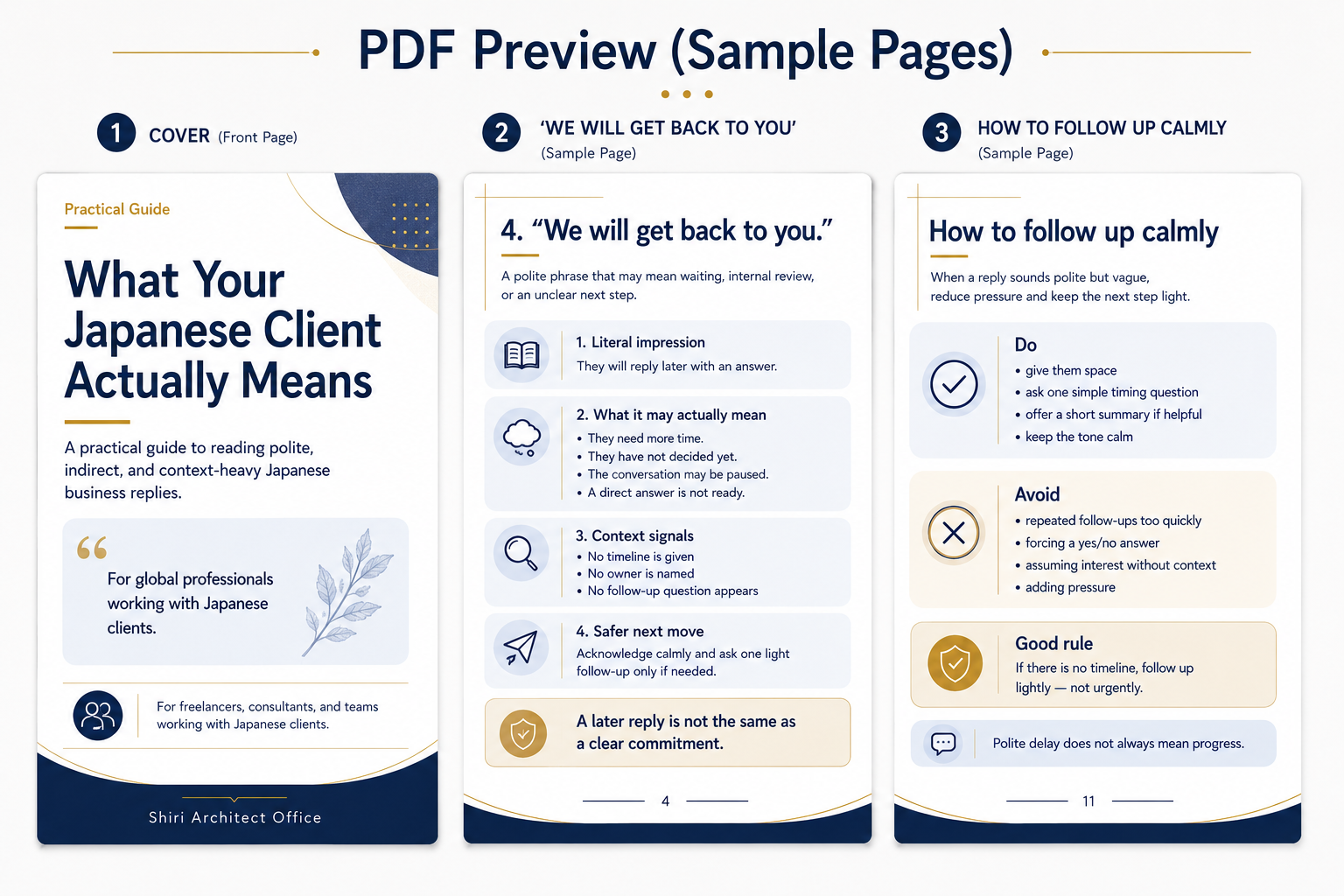
Want a practical guide to reading polite Japanese client replies?
I created a PDF guide called What Your Japanese Client Actually Means.
It helps freelancers, consultants, translators, localization professionals, and teams understand common Japanese business replies such as:
- “We will consider it.”
- “We will discuss it internally.”
- “That may be difficult.”
- “We will review it.”
- “We will get back to you.”
The guide explains possible meanings, context signals, and safer next moves.





コメント
コメント一覧 (1件)
[…] problem isn’t the silence. The problem is that the same reply pattern — “We will get back to you,” “We are checking internally,” “Could you give us a little more […]