You received a reply from your Japanese client. You ran it through a translation tool. The English looked polite, professional, and clear. And yet — you still weren’t sure whether to wait, follow up, or change your approach entirely.
The words may be clear, but the business signal may still be unclear.
That gap is exactly what this framework is designed to close.
Why Translation Alone Is Not Enough
Translation converts words. It does not convert context.
In Japanese business communication, professional signals travel through timing, phrasing, and structure — not just vocabulary. A reply that reads as neutral may be signaling caution. A reply that reads as positive may be communicating restraint rather than enthusiasm.
This is not about secret meanings or cultural mystery. It is about how business context shapes the signal embedded in a reply — and how to read that signal before choosing your next move.
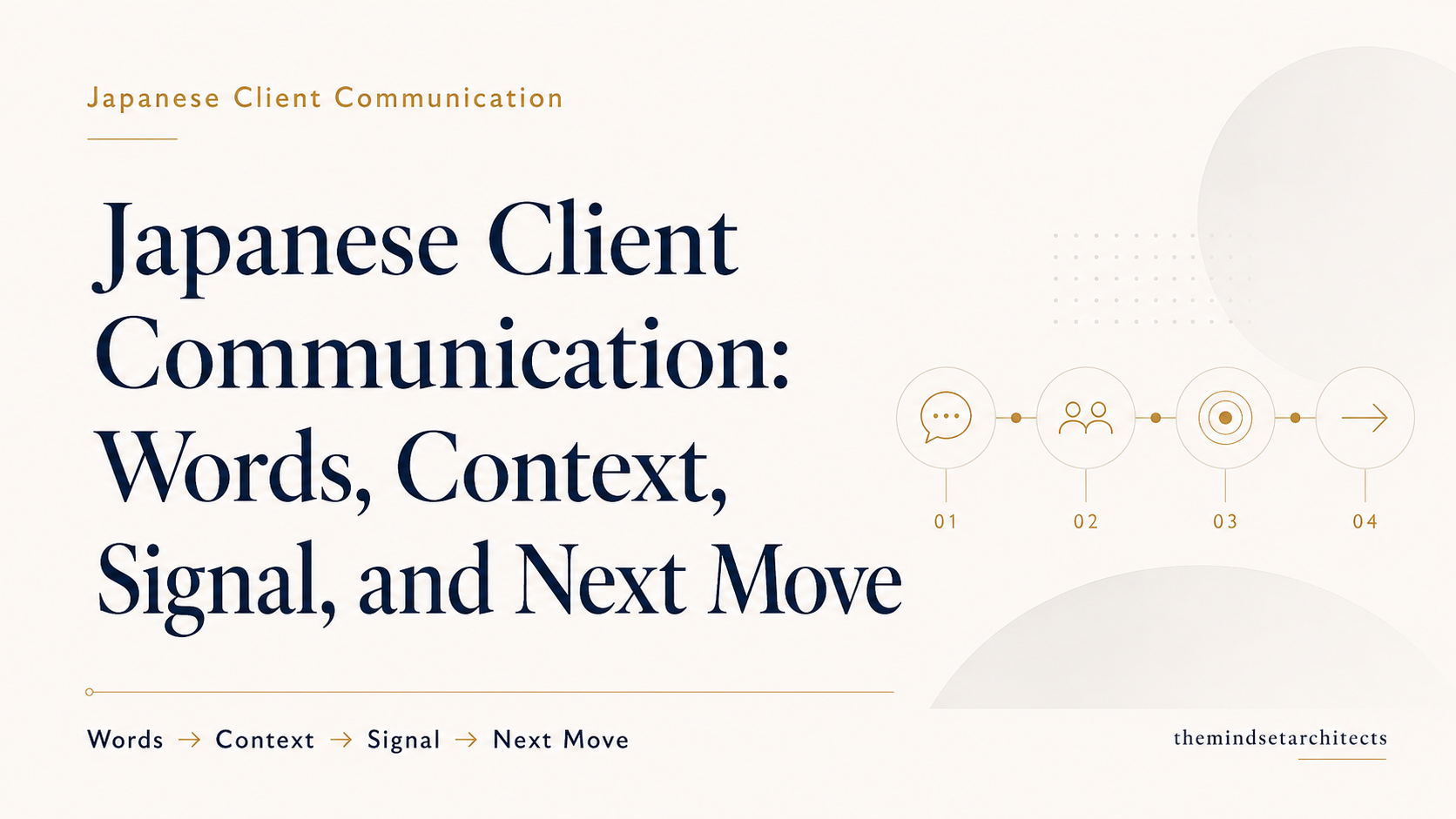
The Framework: Words → Context → Signal → Next Move
Step 1: Words
Start with the literal message. What did your client actually write?
Note the exact phrasing before interpreting. A slight difference in wording — “we will consider it” versus “we will review the details” — may carry different signals once context is applied.
Example: “We will consider it.”
Step 2: Context
Now look at the surrounding situation.
Context includes: Where are you in the relationship? Is this early-stage, mid-negotiation, or a long-running account? What happened in the previous exchange? What is the timing — is there a deadline approaching, or is this an open-ended discussion?
These factors shape what a phrase signals more than the phrase itself does.
Example: “We will consider it” — sent 48 hours after you submitted a revised proposal, by a contact who has been consistently responsive until now.
That shift in timing is context. It is part of the message.
Step 3: Signal
With both words and context in view, you can now ask: what might this reply be indicating?
Signal is not a fixed translation. It is a range of possible meanings, weighted by the context you have identified. The goal is not certainty — it is to narrow the range enough to choose a reasonable next move.
Example: “We will consider it” in the context above may signal:
- They need internal approval before responding
- The revised terms raised a concern that has not been stated directly
- The timeline is slower than your side assumed
- Engagement has shifted and the conversation may be slowing
Recognizing the range prevents you from treating an ambiguous reply as a simple confirmation and moving forward on an assumption that may not hold.
Step 4: Next Move
Once you have identified the signal range, you can choose your response with more precision.
The right next move depends on which signal seems most likely — and which risk you are most trying to avoid. In some situations, waiting and letting the process continue is the right call. In others, a low-pressure check-in may help. In others still, revisiting a specific element of your proposal may address something that has not been stated.
Example: If “We will consider it” seems to reflect an internal approval process, a patient follow-up after a reasonable interval — rather than immediate pressure — is more likely to keep the conversation open.
The framework does not tell you what to do. It tells you what information you have, and gives you a more stable foundation for making that decision yourself.
Why This Matters for Teams
Business decisions about Japanese client relationships are rarely made by one person. A project manager reads the reply. An account lead decides the next step. A sales director sets the timeline.
When different people on the same team interpret the same reply differently — one seeing momentum, one seeing hesitation — the result is misaligned follow-ups, internal pressure that doesn’t match client expectations, and relationships that deteriorate not because of the client, but because of internal miscommunication.
The Words → Context → Signal → Next Move framework gives teams a shared language for reading these situations. Instead of “I think they’re still interested,” the conversation becomes: “The words were neutral, the timing shifted, the signal may be internal review — the next move is probably a patient check-in, not a push.”
That shift in how the team talks about the reply changes how they act on it.
Where This Framework Applies
This four-step approach is useful any time a Japanese business reply leaves you uncertain about the next step.
It is particularly relevant for:
- Proposal responses that feel neither confirmed nor declined
- Follow-up situations where you are not sure whether to wait or reach out
- Replies that seem positive in tone but have not moved toward a decision
- Moments where the relationship feels intact but forward momentum is unclear
It also helps when a reply arrives after an unexpected delay, when a contact who was engaged becomes quieter, or when the language shifts in ways that are hard to name but easy to notice.
This is the framework the guide is built around. What Your Japanese Client Actually Means applies Words → Context → Signal → Next Move to 10 common Japanese business reply patterns — with context signals, signal ranges, and practical guidance for choosing your next move.





コメント
コメント一覧 (1件)
[…] This four-part structure is a more complete version of the same idea — and it’s useful when a reply feels particularly ambiguous. […]