You asked a Japanese client for a change, an extension, or a new arrangement. They replied:
“That may be difficult.”
Your first instinct might be to push a little.
To explain further.
To ask why.
Before you do, it is important to understand what “that may be difficult” often means in Japanese business communication — and how to respond without damaging the relationship.
What the phrase sounds like vs. what it may mean
In English, “that may be difficult” can sound like hesitation.
It may sound as if the door is still open.
It may seem like more explanation, a revised request, or a stronger reason might change the answer.
In Japanese business communication, this phrase often works differently.
It is one of the common ways to decline a request without using a direct “no.”
The logic behind it is relational.
A direct refusal can feel abrupt. It can create awkwardness or damage the working relationship.
A softer phrase that communicates difficulty without direct confrontation is often preferred.
“That may be difficult” can be that soft phrase.
When it may be a genuine maybe
Not every use of this phrase is a refusal.
Sometimes the client genuinely needs to check internally before confirming.
Signals that it may still be open:
- They followed up with a question or asked for more details
- They mentioned a specific constraint, such as budget, timing, or internal approval
- The overall tone of the conversation has stayed warm and engaged
- They suggested an alternative or a modified version
If these signals are present, the conversation may still be moving.
Give it space, then follow up once with a calm, low-pressure question.
When it may already be a no
In many cases, “that may be difficult” is the answer — not the start of a negotiation.
Signals that this is likely a refusal:
- No alternative was offered
- No reason or constraint was explained
- The reply was brief and formal
- No next step or follow-up was suggested
- The tone felt more distant than previous messages
When these signals appear together, pushing harder is unlikely to change the outcome.
It is more likely to create discomfort and strain the relationship quietly.
The most common mistake
The most common mistake is treating this phrase as a simple maybe and continuing to push.
This often looks like:
- Sending a follow-up that repeats the original request in different words
- Asking, “Is there any way to make this work?”
- Explaining why the request is reasonable or important
- Asking for a clear yes or no directly
Each of these responses can put pressure on a client who may already be trying to close the topic politely.
The result may be a longer silence, a more formal refusal, or a quieter loss of trust.
How to respond well
The safest response to “that may be difficult” depends on whether you read it as a genuine maybe or a soft no.
If you think it may still be open:
“Thank you for letting me know. If it would help, I am happy to adjust the scope or timing. Please let me know what would work better on your end.”
This keeps the door open without repeating pressure.
It gives the client a way to re-engage if they want to.
If you read it as a refusal:
“Thank you for your reply. I understand. Please feel free to reach out if the situation changes or if there is anything else I can help with.”
This closes the exchange gracefully.
It protects the relationship and leaves the client with a positive impression, which can matter more than the outcome of a single request.
What to read alongside the words
When a Japanese client reply feels unclear, the words alone are only part of the message.
Read these signals alongside the phrase:
- What is missing — No alternative, no timeline, and no question back may mean the topic is closing
- Tone compared to earlier — A cooler or more formal tone than previous messages can be a signal
- How long the reply took — A delayed reply with little content may signal low priority or reluctance
Reading the context alongside the words gives you a much more accurate picture of where the conversation actually stands.
Other phrases that work in a similar way
“That may be difficult” is one of several Japanese business replies that can carry more than their surface meaning.
Other common examples include:
- “We will consider it.” — This may mean genuine interest, low priority, or a quiet no depending on context.
- “We will discuss it internally.” — This often means the conversation is paused, not necessarily progressing.
- “We will review it.” — This may mean checking, but not necessarily moving forward.
- “Thank you for your understanding.” — This can carry an expectation that you accept the current situation.
Each phrase has a surface meaning and a context-dependent meaning.
Reading both is what helps you avoid misreading Japanese business communication.
If you work with Japanese clients regularly
Learning to read these phrases accurately — rather than only at face value — is one of the most practical skills for anyone working with Japanese clients over time.
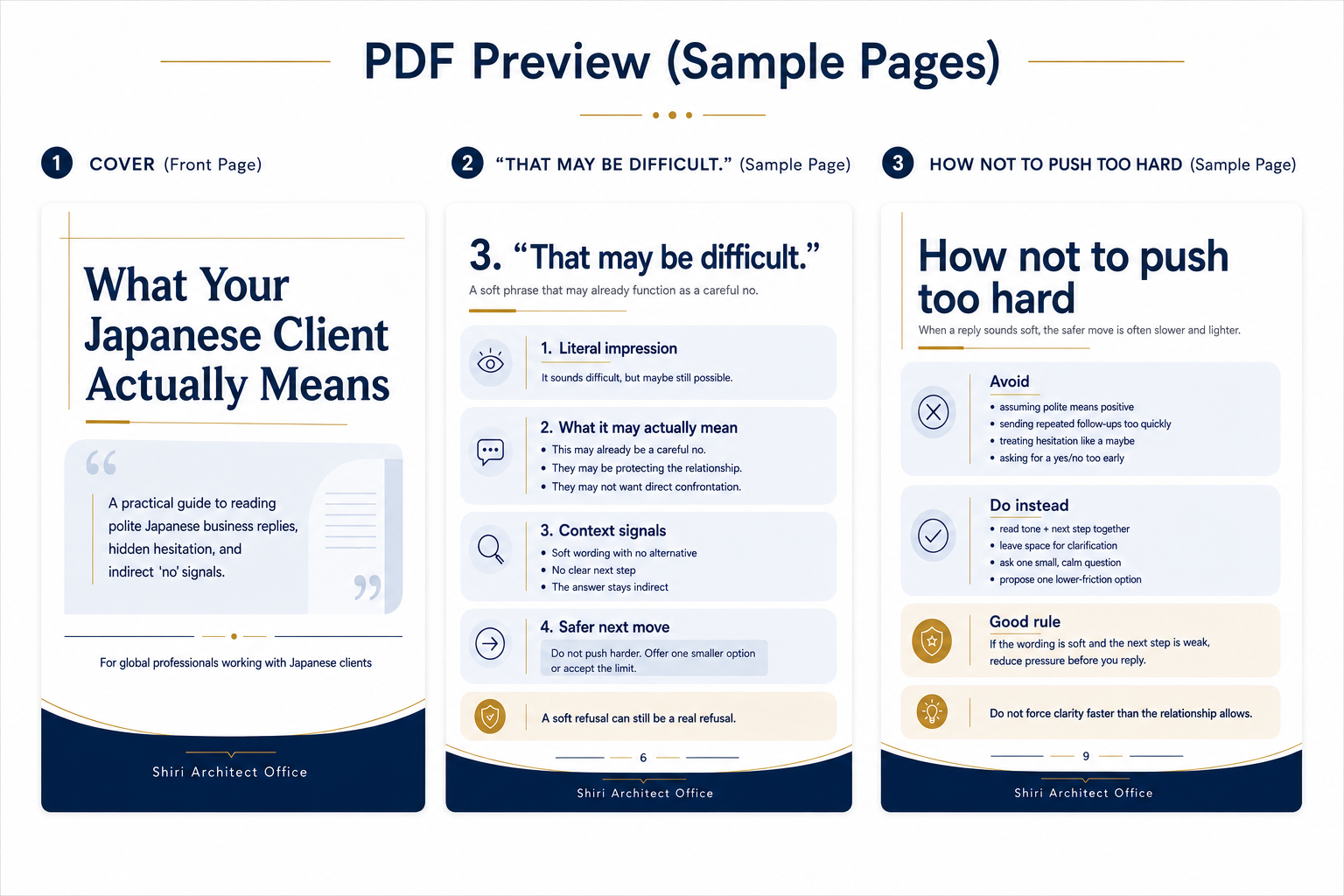
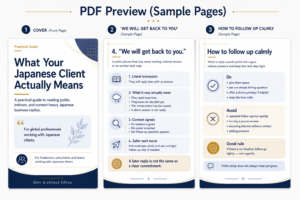
If you often wonder what a Japanese client’s polite reply actually means, I created a PDF guide that covers common phrases in more detail.
What Your Japanese Client Actually Means
A practical guide to reading polite, indirect, and context-heavy Japanese business replies.
For freelancers, consultants, and teams working with Japanese clients.
Written by Atsuko Masamoto — Shiri Architect Office
English-to-Japanese communication and localization specialist based in Japan.






コメント